
Studbook rules Irish Cob Society Netherlands
Breeding objective
Promoting the registration of Irish Cobs. Preserving knowledge of the pedigree of these animals and maintaining and improving the Irish Cob breed.
This is achieved by:
– inspecting animals with the aim of including them in the Supplementary Section of the studbook;
– inspecting stallions and mares that are included in one of the studbook sections with the aim of determining whether they are suitable for use in the breeding programme;
– preserving the Irish Cob breed in its traditional form, compact, powerful, hard-working (cold-blooded).
Characteristics of the breed.
The Irish Cob is classified as a working versatility horse (as opposed to the cart horse, which is a smooth-boned warmblood). The breed should therefore not be too light-boned, as this would also cause the characteristic leg hair (socks) to disappear.
Studbook registers.
The studbook consists of a Main Section and a Supplementary Section.
The Main Section consists of four classes: Class 1, Class 2, Class 3 and Class 4.
Class 4 is the Foal Class, which is subdivided into Class 4 1A, Class 4 1B, Class 4 2A and Class 4 2B.
The Supplementary Section consists of five classes: Sup Class 1, Sup Class 2, Sup Class 3, Sup Class 4 and Grade Up Class.
Conditions for registration in the studbook
To qualify for registration in the Main Section of the studbook, an animal must:
1. Be identified as a foal at the foot of the mare in accordance with the rules of the studbook.
The pedigree must be verified by means of DNA analysis.
2. Both parents must be registered in the Main Section or the Supplementary Section of the Irish Cob studbook.
To qualify for entry into the Supplementary Section of the studbook, an animal must:
be identified in accordance with the studbook rules, it must meet the breed standard upon inspection by the studbook and achieve a minimum performance as laid down in the Studbook Rules.
Conditions for registration in one of the Main Section classes:
A difference is made between Traditional Type Medium and Heavy, and Sporthorse Type.
The type is determined at an inspection by approved ICS inspectors
An inspection form is showed in Appendix 1.
Class 1
IC stallions, mares and geldings are classified in this class if they meet the following criteria:
– they are registered in the Main Section of the IC Studbook
– the sire is registered in Class 1, Class 2, Class 3, Class 4, Supp Class 1, Supp Class 2, the HB register or the HB Premium register, and
– the dam is registered in Class 1, Class 2, Class 3, Class 4, Supp Class 1, Supp Class 2, HB register or HB Premium register in the IC Studbook, and
– they have obtained the required number of points at a studbook inspection to be included in Class 1; stallions must also be veterinary approved.
Class 2
IC stallions, mares and geldings are classified in this class if they meet the following criteria:
– they are registered in the Main Section of the IC Studbook
– the sire is registered in Class 1, Class 2, Class 3, Class 4, Supp Class 1, Supp Class 2, the HB register or the HB Premium register and the dam is registered in Class 1, Class 2, Class 3,
Class 4, Supp Class 1, Supp Class 2, HB register or HB Premium register in the IC Studbook, and
– they have not achieved the required number of points at a studbook inspection to be included in Class 1; stallions must be veterinary approved.
Class 3
IC stallions, mares and geldings are classified in this class if they meet the following criteria:
– they are registered in the Main Section of the IC Studbook, and
– the sire is registered in Class 1, Class 2, Class 3, Class 4, Supp Class 1, Supp Class 2, the HB register or the HB Premium register, and
– the dam is registered in Class 1, Class 2, Class 3, Class 4, Supp Class 1, Supp Class 2, HB register or HB Premium register in the IC Studbook, and
– they have not achieved the required number of points at a studbook inspection to be included in Class 2 and/or they have been rejected by a veterinarian.
Class 3 Irish Cobs are not recommended for breeding.
Class 4
IC stallions, mares and geldings are classified in this class if they meet the following criteria:
– they are registered in the Main Section of the IC Studbook, and
– they have not been to a studbook inspection.
Class 4 is subdivided into Class 4 1A, Class 4 1B, Class 4 2A and Class 4 2B:
Class 4 1A means: the foal’s sire is Class 1 or Class 2, the dam is Class 1 or Class 2.
Class 4 1B means: the foal’s sire is Class 1 or Class 2, the dam is Class 3 or Class 4
Class 4 2A means: the foal’s sire is Class 3 or Class 4, the dam is Class 1 or Class 2.
Class 4 2B means: the foal’s sire is Class 3 or Class 4, the dam is Class 3 or Class 4.
Appendix 2 contains a detailed table indicating the Class and affix in which a foal is placed, depending on the Classes of the sire and dam.
Conditions for registration in one of the Supplement classes:
The Supplement section of the IC Studbook is divided into Supplement Class 1 (Sup Class 1), Sup Class 2, Sup Class 3 and Sup Class 4.
To qualify for registration in the Supplement section of the studbook, an animal must:
Sup Class 1
– be not eligible for registration in the Main Section of the IC Studbook, and
– be registered in the Supplementary Section of the IC Studbook, and
– be born from a stallion or mare classified as Sup Class 3 or Sup Class 4 in the IC Studbook, and
– have obtained the minimum number of points at a studbook inspection to be eligible for Class 1, and
– have been approved by a veterinarian.
Sup Class 2
– be not eligible for registration in the Main Section of the IC Studbook, and
– be registered in the Supplementary Section of the IC Studbook, and
– be born from a stallion or mare classified as Sup Class 3 or Sup Class 4 in the IC Studbook, and
– have not achieved the minimum number of points in a studbook inspection to be eligible for Class 1, and
– have been approved by a veterinarian.
Sup Class 3
– are not eligible for registration in the Main Section of the IC Studbook, and
– are registered in the Supplementary Section of the IC Studbook, and
– are not veterinary approved and are not eligible for Sup Class 1 and 2
Sup Class 3 Irish Cobs are not recommended for breeding.
Sup Class 4
– be not eligible for registration in the Main Section of the IC Studbook, and
– be registered in the Supplementary Section of the IC Studbook, and
– be not veterinary approved and not eligible for Sup Class 1 and 2
Upgrading of offspring from the Supplement Section
The offspring of mares registered in the Supplement Section may be admitted to the Main Section of the IC Studbook if they are descended from a parent (sire or dam) classified in the IC Studbook and a parent classified in the Irish Cob Part-Bred Studbook, and
– have three grandparents classified in the Irish Cob Studbook, and
– have been classified in Class 1 or Class 2 at a grading.
Mares upgraded in the Grade Up Register of the Supplementary Section will retain their original classification in the ICPB Studbook, but their identification document will state they are also classified in the Supplementary Section (Grade Up Register) of the IC Studbook.
The system for recording ancestry.
• In order to include both parents in the pedigree, parentage must be proven by means of DNA analysis.
• If parentage has been verified by means of DNA analysis, a copy of this must be included in the records of the Irish Cob Nederland organization.
• ICS reserves the right to have a DNA analysis carried out on all registered horses.
The system for identifying Irish Cobs for entry into the studbook.
• To select mares registered in the Main Section of the studbook via premium inspection for the selective breeding programme.
• To be able to issue identification documents for all equines included in the studbook.
• To include the certificate of origin and identity characteristics in the identity document.
• To be able to issue a UELN (Unique European Life Number) for all horses for which a passport is issued.
• Registered names may not be copied within the studbook. Breeders can make an animal’s name unique by adding their own unique stable name.
Microchipping is mandatory. The microchip (transponder) number is included in the equine passport.
General
• Irish Cobs registered in an approved Irish Cob Studbook may be entered in another Irish Cob Studbook in a section and class corresponding to the characteristics of the animal.
• Organisations may not discriminate against breeders or owners.
Animals that meet the requirements of Commission Decision 96/78/EC are eligible and entitled to be registered in an Irish Cob Studbook.
Procedures for inspecting stallions, mares and geldings for entry.
At least two inspectors, at least one of whom must be a Grade 1 inspector, are authorised to carry out the inspection for the purpose of admitting stallions, mares and geldings to Class 1 or Class 2 or Sup Class 1 or Sup Class 2.
They use the inspection score form in Appendix 1.
Stallions must also be examined by a qualified veterinarian. Mares and geldings must be healthy enough to undergo the inspection.
During this inspection, the horses are also measured.
If DNA is not yet available, hair samples are also taken for DNA analysis.
Once the stallions has been upgraded at the inspection, this is noted in the passport and in the Irish Cob Society database.
The owners of horses that are not approved are given the opportunity to present their horses again at a subsequent inspection. However, they must pay for this again.
The approval of a stallion at the age of 2, 3 or 4 expires at 5 years. At 5 years or older, the stallion must be re-inspected for final approval.
Sports titles can also be obtained during the inspections.
Sport predicates can also be obtained during the inspections.
Upgrading offspring in the Supplement section
Foals from mares classified in the Supplementary Section may be included in the Main Section of the IC Studbook if they are descended from stallions classified in Class 1 or Class 2.
Foals from stallions classified in the Supplementary Section may be included in the Main Section if the dam is classified in Class 1 or Class 2.
Cross-breeding programm
The IC Studbook runs a cross-breeding programme. Animals listed in the Main Studbook of Studbooks with recognised pedigrees in the list below can participate in the cross-breeding programme under the conditions set out below.
For stallions, this includes the Irish Piebald and Skewbald Association, the Gypsy Cob, the Coloured Horse and the Tinker.
For mares, this also applies to Irish Cob Part-Bred (see upgrading) and Studbook-registered Welsh Cobs.
Procedures for inspecting stallions, mares and geldings for classification in the Irish Cob Studbook
Stallions must be registered in the studbook before being inspected.
Stallions are inspected by at least two inspectors, at least one of whom must be a grade 1 inspector. All stallions must also undergo a veterinary inspection.
– Stallions are inspected in hand, at a walk and at a trot, using the stallion inspection form in Appendix 1.
– All stallions are measured during the inspection.
– If not already available, a hair sample will be taken for DNA testing.
– ICS reserves the right to terminate an inspection if there is a danger to ICS officials or bystanders.
– If a new classification is achieved, this will be noted in the horse’s passport and in the studbook database.
The same rules apply to mares. If a health problem is discovered during the inspection, the inspection will be terminated.
Mares and geldings must be at least 3 years old to participate in the inspection.
If a horse is rejected during the inspection, the owner will be given the opportunity to re-register the horse for another inspection. However, this will require payment of the inspection fee again.
Irish Cob Studbook Inspectors
Grade 1 inspectors have successfully completed training at the IC Studbook and are authorised to include horses in the Supplement Section and are authorised to inspect horses for upgrading to Class 1 and Sup Class 1.
Grade 2 inspectors are authorised to assess a horse against the IC Breed Standard with the aim of inspecting horses for inclusion in the Supplement Section.
They have completed the training at the IC Studbook.
The inspections are carried out using the inspection form as in Appendix 1.
For a schematic list of the method of registration at birth, see Appendix 2.
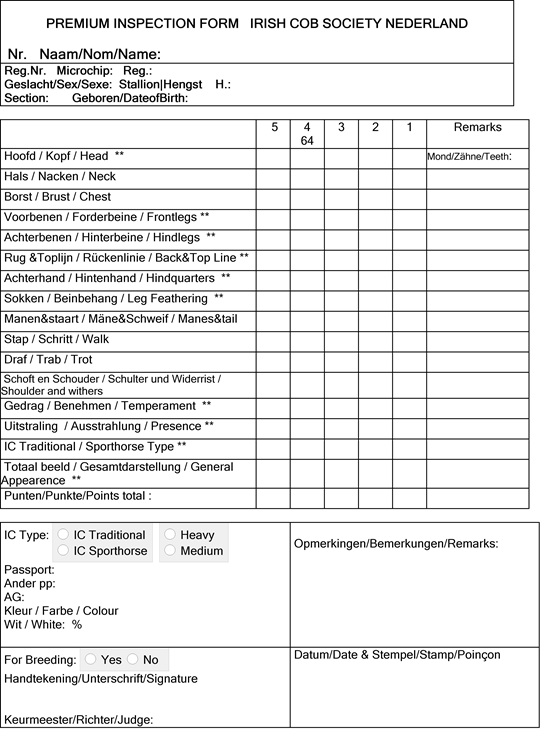
Class 1: IC Traditional Type must score 4 points or more for items with **, other items must be 3 points or more.
Mares and geldings may score 3 points for legs and legfeathering and be registered as Traditional Type medium.
IC Sporthorse must score 3 points or more for legfeathering but must have 4 points or more for walk and trot.
The total score must be at least 58 points.
Class 2: IC Traditional and Sporthorse must score at least 48 points and must not have a score 1 in the list.
Class 3: All horses not fitting the demands above
Appendix 2: SCHEME for registering Irish Cob foals at birth |
|||||||||||
|
DAM |
Class 1 |
Class 2 |
Class 3 |
Class 4 |
HB Premie |
HB |
Sup Class 1 |
Sup Class 2 |
Grade Up |
Sup Class 3 |
Sup Class 4 |
|
SIRE |
|||||||||||
|
Class 1 |
Class 4 1A |
Class 4 1A |
Class 4 1B |
Class 4 1B |
Class 4 1A |
Class 4 1B |
Class 4 1A |
Class 4 1A |
Class 4 1A |
Sup Class 4 1B |
Sup Class 4 1B |
|
Class 2 |
Class 4 1A |
Class 4 1A |
Class 4 1B |
Class 4 1B |
Class 4 1A |
Class 4 1B |
Class 4 1A |
Class 4 1A |
Class 4 1A |
Sup Class 4 1B |
Sup Class 4 1B |
|
Class 3 |
Class 4 2A |
Class 4 2A |
Class 4 2B |
Class 4 2B |
Class 4 2A |
Class 4 2B |
Class 4 2A |
Class 4 2A |
Class 4 2A |
Sup Class 4 2B |
Sup Class 4 2B |
|
Class 4 |
Class 4 2A |
Class 4 2A |
Class 4 2B |
Class 4 2B |
Class 4 2A |
Class 4 2B |
Class 4 2A |
Class 4 2A |
Class 4 2A |
Sup Class 4 2B |
Sup Class 4 2B |
|
HB Premium |
Class 4 1A |
Class 4 1A |
Class 4 1B |
Class 4 1B |
Class 4 1A |
Class 4 1B |
Class 4 1A |
Class 4 1A |
Class 4 1A |
Sup Class 4 1B |
Sup Class 4 1B |
|
HB |
Class 4 2A |
Class 4 2A |
Class 4 2B |
Class 4 2B |
Class 4 2A |
Class 4 2B |
Class 4 2A |
Class 4 2A |
Class 4 2A |
Sup Class 4 2B |
Sup Class 4 2B |
|
Sup Class 1 |
Class 4 1A |
Class 4 1A |
Sup Class 4 1B |
Sup Class 4 1B |
Class 4 1A |
Class 4 1B |
Class 4 1A |
Class 4 1A |
Class 4 1A |
Sup Class 4 1B |
Sup Class 4 1B |
|
Sup Class 2 |
Class 4 1A |
Class 4 1A |
Sup Class 4 1B |
Sup Class 4 1B |
Class 4 1A |
Class 4 1B |
Class 4 1A |
Class 4 1A |
Class 4 1A |
Sup Class 4 1B |
Sup Class 4 1B |
|
Sup Class 3 |
Sup Class 4 |
Sup Class 4 |
Sup Class 4 |
Sup Class 4 |
Sup Class 4 |
Sup Class 4 |
Sup Class 4 |
Sup Class 4 |
Sup Class 4 |
Sup Class 4 |
Sup Class 4 |
|
Sup Class 4 |
Sup Class 4 |
Sup Class 4 |
Sup Class 4 |
Sup Class 4 |
Sup Class 4 |
Sup Class 4 |
Sup Class 4 |
Sup Class 4 |
Sup Class 4 |
Sup Class 4 |
Sup Class 4 |
Example:
if the mare is registered in HB Premium and the stallion in Class 2, the foal will be placed in Class 4 1A. (light grey bar, rightmost box)
Studbook rules Irish Cob Society Netherlands
Breeding objective
Promoting the registration of Irish Cobs. Preserving knowledge of the pedigree of these animals and maintaining and improving the Irish Cob breed.
This is achieved by:
– inspecting animals with the aim of including them in the Supplementary Section of the studbook;
– inspecting stallions and mares that are included in one of the studbook sections with the aim of
determining whether they are suitable for use in the breeding programme;
– preserving the Irish Cob breed in its traditional form, compact, powerful, hard-working
(cold-blooded).
Characteristics of the breed.
The Irish Cob is classified as a working versatility horse (as opposed to the cart horse, which is a smooth-boned warmblood). The breed should therefore not be too light-boned, as this would also cause the characteristic leg hair (socks) to disappear.
Studbook registers.
The studbook consists of a Main Section and a Supplementary Section.
The Main Section consists of four classes: Class 1, Class 2, Class 3 and Class 4.
Class 4 is the Foal Class, which is subdivided into Class 4 1A, Class 4 1B, Class 4 2A and Class 4 2B.
The Supplementary Section consists of five classes: Sup Class 1, Sup Class 2, Sup Class 3, Sup Class 4 and Grade Up Class.
Conditions for registration in the studbook
To qualify for registration in the Main Section of the studbook, an animal must:
1. Be identified as a foal at the foot of the mare in accordance with the rules of the studbook.
The pedigree must be verified by means of DNA analysis.
2. Both parents must be registered in the Main Section or the Supplementary Section of the Irish Cob studbook.
To qualify for entry into the Supplementary Section of the studbook, an animal must:
be identified in accordance with the studbook rules, it must meet the breed standard upon inspection by the studbook and achieve a minimum performance as laid down in the Studbook Rules.
Conditions for registration in one of the Main Section classes:
A difference is made between Traditional Type Medium and Heavy, and Sporthorse Type.
The type is determined at an inspection by approved ICS inspectors
An inspection form is showed in Appendix 1.
Class 1
IC stallions, mares and geldings are classified in this class if they meet the following criteria:
– they are registered in the Main Section of the IC Studbook
– the sire is registered in Class 1, Class 2, Class 3, Class 4, Supp Class 1, Supp Class 2, the HB register or the HB Premium register, and
– the dam is registered in Class 1, Class 2, Class 3, Class 4, Supp Class 1, Supp Class 2, HB register or HB Premium register in the IC Studbook, and
– they have obtained the required number of points at a studbook inspection to be included in Class 1; stallions must also be veterinary approved.
Class 2
IC stallions, mares and geldings are classified in this class if they meet the following criteria:
– they are registered in the Main Section of the IC Studbook
– the sire is registered in Class 1, Class 2, Class 3, Class 4, Supp Class 1, Supp Class 2, the HB register or the HB Premium register and the dam is registered in Class 1, Class 2, Class 3,
Class 4, Supp Class 1, Supp Class 2, HB register or HB Premium register in the IC Studbook, and
– they have not achieved the required number of points at a studbook inspection to be included in
Class 1; stallions must be veterinary approved.
Class 3
IC stallions, mares and geldings are classified in this class if they meet the following criteria:
– they are registered in the Main Section of the IC Studbook, and
– the sire is registered in Class 1, Class 2, Class 3, Class 4, Supp Class 1, Supp Class 2, the HB register or the HB Premium register, and
– the dam is registered in Class 1, Class 2, Class 3, Class 4, Supp Class 1, Supp Class 2, HB register or HB Premium register in the IC Studbook, and
– they have not achieved the required number of points at a studbook inspection to be included in Class 2 and/or they have been rejected by a veterinarian.
Class 3 Irish Cobs are not recommended for breeding.
Class 4
IC stallions, mares and geldings are classified in this class if they meet the following criteria:
– they are registered in the Main Section of the IC Studbook, and
– they have not been to a studbook inspection.
Class 4 is subdivided into Class 4 1A, Class 4 1B, Class 4 2A and Class 4 2B
Class 4 1A means: the foal’s sire is Class 1 or Class 2, the dam is Class 1 or Class 2.
Class 4 1B means: the foal’s sire is Class 1 or Class 2, the dam is Class 3 or Class 4
Class 4 2A means: the foal’s sire is Class 3 or Class 4, the dam is Class 1 or Class 2.
Class 4 2B means: the foal’s sire is Class 3 or Class 4, the dam is Class 3 or Class 4.
Appendix 2 contains a detailed table indicating the Class and affix in which a foal is placed, depending on the Classes of the sire and dam.
Conditions for registration in one of the Supplement classes:
The Supplement section of the IC Studbook is divided into Supplement Class 1 (Sup Class 1),
Sup Class 2, Sup Class 3 and Sup Class 4.
To qualify for registration in the Supplement section of the studbook, an animal must:
Sup Class 1
– be not eligible for registration in the Main Section of the IC Studbook, and
– be registered in the Supplementary Section of the IC Studbook, and
– be born from a stallion or mare classified as Sup Class 3 or Sup Class 4 in the IC Studbook, and
– have obtained the minimum number of points at a studbook inspection to be eligible for Class 1, and
– have been approved by a veterinarian.
Sup Class 2
– be not eligible for registration in the Main Section of the IC Studbook, and
– be registered in the Supplementary Section of the IC Studbook, and
– be born from a stallion or mare classified as Sup Class 3 or Sup Class 4 in the IC Studbook, and
– have not achieved the minimum number of points in a studbook inspection to be eligible for Class 1, and
– have been approved by a veterinarian.
Sup Class 3
– are not eligible for registration in the Main Section of the IC Studbook, and
– are registered in the Supplementary Section of the IC Studbook, and
– are not veterinary approved and are not eligible for Sup Class 1 and 2
Sup Class 3 Irish Cobs are not recommended for breeding.
Sup Class 4
– be not eligible for registration in the Main Section of the IC Studbook, and
– be registered in the Supplementary Section of the IC Studbook, and
– be not veterinary approved and not eligible for Sup Class 1 and 2
Upgrading of offspring from the Supplement Section
The offspring of mares registered in the Supplement Section may be admitted to the Main Section of the IC Studbook if they are descended from a parent (sire or dam) classified in the IC Studbook and a parent classified in the Irish Cob Part-Bred Studbook, and
– have three grandparents classified in the Irish Cob Studbook, and
– have been classified in Class 1 or Class 2 at a grading.
Mares upgraded in the Grade Up Register of the Supplementary Section will retain their original classification in the ICPB Studbook, but their identification document will state they are also classified in the Supplementary Section (Grade Up Register) of the IC Studbook.
The system for recording ancestry.
• In order to include both parents in the pedigree, parentage must be proven by means of DNA analysis.
• If parentage has been verified by means of DNA analysis, a copy of this must be included in the records of the Irish Cob Nederland organization.
• ICS reserves the right to have a DNA analysis carried out on all registered horses.
The system for identifying Irish Cobs for entry into the studbook.
• To select mares registered in the Main Section of the studbook via premium inspection for the selective breeding programme.
• To be able to issue identification documents for all equines included in the studbook.
• To include the certificate of origin and identity characteristics in the identity document.
• To be able to issue a UELN (Unique European Life Number) for all horses for which a passport is issued.
• Registered names may not be copied within the studbook. Breeders can make an animal’s name unique by adding their own unique stable name.
Microchipping is mandatory. The microchip (transponder) number is included in the equine passport.
General
• Irish Cobs registered in an approved Irish Cob Studbook may be entered in another Irish Cob Studbook in a section and class corresponding to the characteristics of the animal.
• Organisations may not discriminate against breeders or owners.
Animals that meet the requirements of Commission Decision 96/78/EC are eligible and entitled to be registered in an Irish Cob Studbook.
Procedures for inspecting stallions, mares and geldings for entry.
At least two inspectors, at least one of whom must be a Grade 1 inspector, are authorised to carry out the inspection for the purpose of admitting stallions, mares and geldings to Class 1 or Class 2 or Sup Class 1 or Sup Class 2.
They use the inspection score form in Appendix 1.
Stallions must also be examined by a qualified veterinarian. Mares and geldings must be healthy enough to undergo the inspection.
During this inspection, the horses are also measured.
If DNA is not yet available, hair samples are also taken for DNA analysis.
Once the stallions has been upgraded at the inspection, this is noted in the passport and in the Irish Cob Society database.
The owners of horses that are not approved are given the opportunity to present their horses again at a subsequent inspection. However, they must pay for this again.
The approval of a stallion at the age of 2, 3 or 4 expires at 5 years. At 5 years or older, the stallion must be re-inspected for final approval.
Sports titles can also be obtained during the inspections.
Sport predicates can also be obtained during the inspections.
Upgrading offspring in the Supplement section
Foals from mares classified in the Supplementary Section may be included in the Main Section of the IC Studbook if they are descended from stallions classified in Class 1 or Class 2.
Foals from stallions classified in the Supplementary Section may be included in the Main Section if the dam is classified in Class 1 or Class 2.
Cross-breeding programm
The IC Studbook runs a cross-breeding programme. Animals listed in the Main Studbook of Studbooks with recognised pedigrees in the list below can participate in the cross-breeding programme under the conditions set out below.
For stallions, this includes the Irish Piebald and Skewbald Association, the Gypsy Cob, the Coloured Horse and the Tinker.
For mares, this also applies to Irish Cob Part-Bred (see upgrading) and Studbook-registered Welsh Cobs.
Procedures for inspecting stallions, mares and geldings for classification in the Irish Cob Studbook
Stallions must be registered in the studbook before being inspected.
Stallions are inspected by at least two inspectors, at least one of whom must be a grade 1 inspector. All stallions must also undergo a veterinary inspection.
– Stallions are inspected in hand, at a walk and at a trot, using the stallion inspection form in Appendix 1.
– All stallions are measured during the inspection.
– If not already available, a hair sample will be taken for DNA testing.
– ICS reserves the right to terminate an inspection if there is a danger to ICS officials or bystanders.
– If a new classification is achieved, this will be noted in the horse’s passport and in the studbook database.
The same rules apply to mares. If a health problem is discovered during the inspection, the inspection will be terminated.
Mares and geldings must be at least 3 years old to participate in the inspection.
If a horse is rejected during the inspection, the owner will be given the opportunity to re-register the horse for another inspection. However, this will require payment of the inspection fee again.
Irish Cob Studbook Inspectors
Grade 1 inspectors have successfully completed training at the IC Studbook and are authorised to include horses in the Supplement Section and are authorised to inspect horses for upgrading to Class 1 and Sup Class 1.
Grade 2 inspectors are authorised to assess a horse against the IC Breed Standard with the aim of inspecting horses for inclusion in the Supplement Section.
They have completed the training at the IC Studbook.
The inspections are carried out using the inspection form as in Appendix 1.
For a schematic list of the method of registration at birth, see Appendix 2.
C lass 1:
Class 1: IC Traditional Type must score 4 points or more for items with **, other items must be 3 points or more.
Mares and geldings may score 3 points for legs and legfeathering and be registered as Traditional Type medium.
IC Sporthorse must score 3 points or more for legfeathering but must have 4 points or more for walk and trot.
The total score must be at least 58 points.
Class 2: IC Traditional and Sporthorse must score at least 48 points and must not have a score 1 in the list.
Class 3: All horses not fitting the demands above
Appendix 2: SCHEME for registering Irish Cob foals at birth |
|||||||||||
|
DAM |
Class 1 |
Class 2 |
Class 3 |
Class 4 |
HB Premie |
HB |
Sup Class 1 |
Sup Class 2 |
Grade Up |
Sup Class 3 |
Sup Class 4 |
|
SIRE |
|||||||||||
|
Class 1 |
Class 4 1A |
Class 4 1A |
Class 4 1B |
Class 4 1B |
Class 4 1A |
Class 4 1B |
Class 4 1A |
Class 4 1A |
Class 4 1A |
Sup Class 4 1B |
Sup Class 4 1B |
|
Class 2 |
Class 4 1A |
Class 4 1A |
Class 4 1B |
Class 4 1B |
Class 4 1A |
Class 4 1B |
Class 4 1A |
Class 4 1A |
Class 4 1A |
Sup Class 4 1B |
Sup Class 4 1B |
|
Class 3 |
Class 4 2A |
Class 4 2A |
Class 4 2B |
Class 4 2B |
Class 4 2A |
Class 4 2B |
Class 4 2A |
Class 4 2A |
Class 4 2A |
Sup Class 4 2B |
Sup Class 4 2B |
|
Class 4 |
Class 4 2A |
Class 4 2A |
Class 4 2B |
Class 4 2B |
Class 4 2A |
Class 4 2B |
Class 4 2A |
Class 4 2A |
Class 4 2A |
Sup Class 4 2B |
Sup Class 4 2B |
|
HB Premium |
Class 4 1A |
Class 4 1A |
Class 4 1B |
Class 4 1B |
Class 4 1A |
Class 4 1B |
Class 4 1A |
Class 4 1A |
Class 4 1A |
Sup Class 4 1B |
Sup Class 4 1B |
|
HB |
Class 4 2A |
Class 4 2A |
Class 4 2B |
Class 4 2B |
Class 4 2A |
Class 4 2B |
Class 4 2A |
Class 4 2A |
Class 4 2A |
Sup Class 4 2B |
Sup Class 4 2B |
|
Sup Class 1 |
Class 4 1A |
Class 4 1A |
Sup Class 4 1B |
Sup Class 4 1B |
Class 4 1A |
Class 4 1B |
Class 4 1A |
Class 4 1A |
Class 4 1A |
Sup Class 4 1B |
Sup Class 4 1B |
|
Sup Class 2 |
Class 4 1A |
Class 4 1A |
Sup Class 4 1B |
Sup Class 4 1B |
Class 4 1A |
Class 4 1B |
Class 4 1A |
Class 4 1A |
Class 4 1A |
Sup Class 4 1B |
Sup Class 4 1B |
|
Sup Class 3 |
Sup Class 4 |
Sup Class 4 |
Sup Class 4 |
Sup Class 4 |
Sup Class 4 |
Sup Class 4 |
Sup Class 4 |
Sup Class 4 |
Sup Class 4 |
Sup Class 4 |
Sup Class 4 |
|
Sup Class 4 |
Sup Class 4 |
Sup Class 4 |
Sup Class 4 |
Sup Class 4 |
Sup Class 4 |
Sup Class 4 |
Sup Class 4 |
Sup Class 4 |
Sup Class 4 |
Sup Class 4 |
Sup Class 4 |
Example:
if the mare is registered in HB Premium and the stallion in Class 2, the foal will be placed in Class 4 1A. (light grey bar, rightmost box)